
What Is Bereavement Leave? Meaning, Eligibility, and How It Works
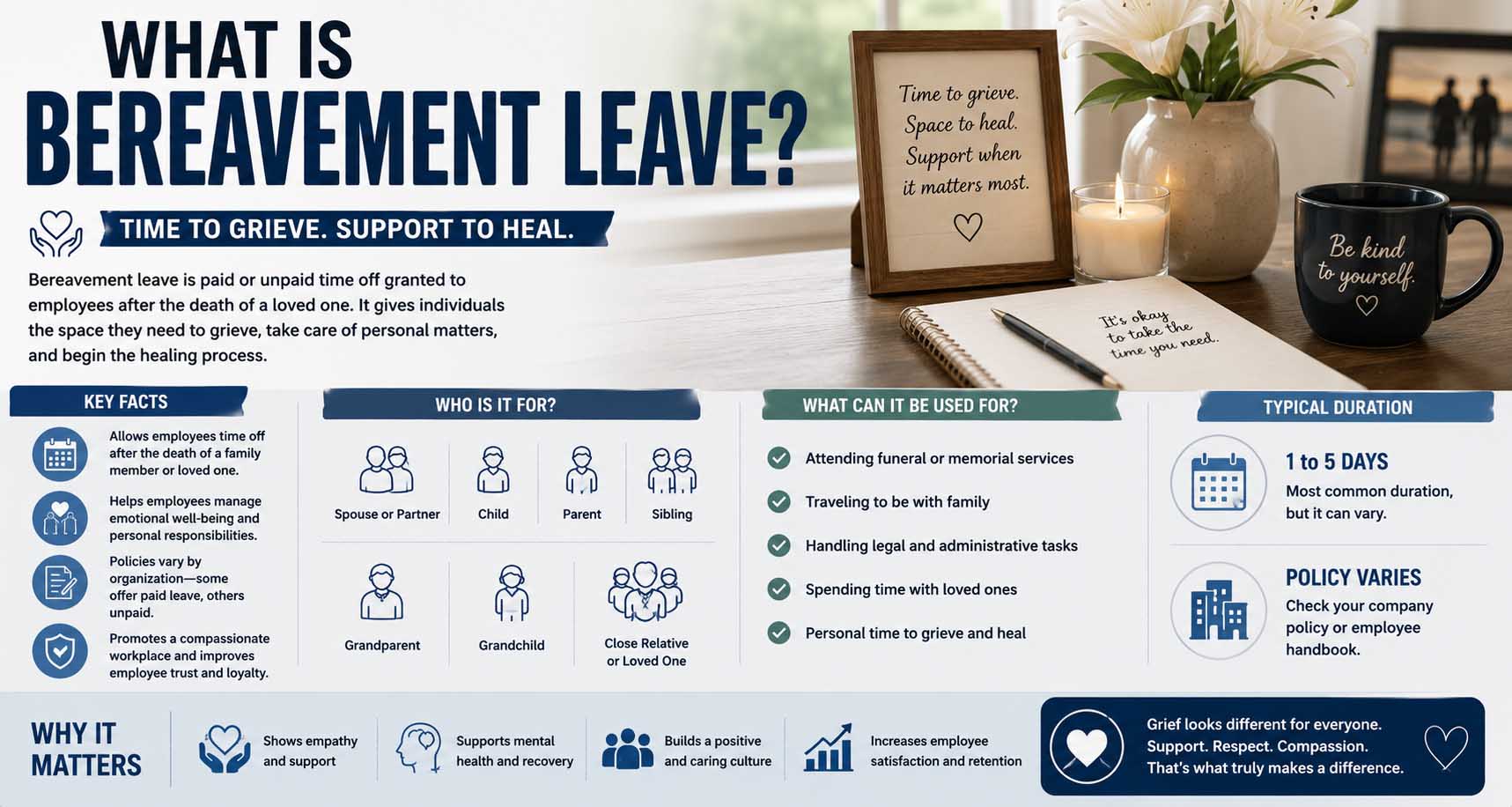
When an employee loses someone close to them, going to work may be the last thing they are ready to handle. So, what is bereavement leave, and how does it help? Bereavement leave is time away from work that an employee may take following the death of a family member or another qualifying person. Depending on the employer and applicable law, the leave may be paid or unpaid and may cover several days or a longer period.
For employees, this time can provide space to grieve, attend a funeral or memorial, make arrangements, travel, and deal with practical responsibilities after a death. For employers, meanwhile, a clear bereavement policy can make a difficult situation easier to manage fairly and consistently.
However, bereavement rules vary widely. Therefore, employees should check their employer’s policy and applicable state, local, or national laws rather than assuming every workplace offers the same benefit.
What Is Bereavement Leave?
Bereavement leave is an employer-approved absence associated with the death of someone close to an employee. In some workplaces, it is also called compassionate leave.
Unlike vacation time, bereavement leave has a specific purpose. Usually, employees use it immediately after learning about a death or around funeral and memorial arrangements. However, policies can allow some flexibility because every situation is different.
For example, one employee might need only a few days to attend a local funeral. Another may need extra time because the funeral requires international travel or because the employee must handle an estate.
Employees who are learning what does PTO stand for may wonder whether bereavement time is simply another form of paid time off. However, employers often treat the two separately. A company may provide dedicated bereavement days without deducting them from an employee’s regular vacation or PTO balance.
What Is Bereavement Leave Used For?
Grieving is one reason for taking leave, but it is not the only one. A death can create several emotional and practical responsibilities at once.
Depending on company policy, bereavement leave may be used to:
- Attend a funeral, burial, cremation, memorial, or related service
- Spend time with close family members
- Make funeral or memorial arrangements
- Travel to and from services
- Handle urgent paperwork
- Manage certain estate or household responsibilities
- Take time away from regular work duties while grieving
As a result, asking what is bereavement leave used for has a broader answer than simply “attending a funeral.”
Still, employees should review their company’s policy before assuming a particular activity qualifies. Some policies describe permitted uses in detail, while others give employees and managers more flexibility.
How Long Is Bereavement Leave?
There is no single amount of bereavement leave that applies to every employee or workplace. Instead, the available time depends on company policy, employment agreements, collective bargaining agreements where applicable, and relevant laws.
For instance, an employer might offer a set number of days following the death of an immediate family member. Meanwhile, it may offer fewer days for another relative. Some companies may also allow managers to approve extra unpaid leave, vacation days, remote work, or flexible scheduling.
Because policies differ, employees should avoid assuming that a common number of days is a legal standard.
If additional time is needed, understanding how does PTO work can also be useful. Depending on the workplace, an employee may be able to combine dedicated bereavement leave with available PTO or vacation time.
Does Bereavement Leave Have to Be Consecutive?
Not necessarily. Some employers require consecutive days, while others allow employees to split the available leave.
For example, an employee might take time immediately after a death and save another day for a memorial service held later. However, the company policy determines whether that arrangement is permitted.
Therefore, employees should speak with their manager or HR department as soon as reasonably possible.
Is Bereavement Leave Paid?
Bereavement leave can be paid or unpaid.
Some employers voluntarily provide paid bereavement leave as an employee benefit. In that case, an eligible employee normally continues receiving their regular wages for the approved leave period, subject to the policy.
Other employers may provide unpaid time away from work. In some cases, employees can choose or may be permitted to use vacation or other available paid leave instead.
The distinction matters because “bereavement leave” describes why the employee is away from work; it does not automatically tell you whether the absence is paid.
Location matters as well. Laws governing bereavement leave can vary between jurisdictions and may change. Consequently, both employers and employees should verify current rules that apply to their location.
What Is Considered Immediate Family for Bereavement Leave?
The phrase “immediate family” often appears in workplace policies, yet its definition is not universal.
Depending on the employer, immediate family may include a:
| Relationship | Commonly addressed by policies? |
|---|---|
| Spouse or domestic partner | Often |
| Child | Often |
| Parent | Often |
| Sibling | Often |
| Grandparent | Sometimes |
| Grandchild | Sometimes |
| Parent-in-law | Sometimes |
| Other relative | Depends on policy |
This table is only a general guide because an employer’s written policy or applicable law controls the actual definition.
Modern policies may also recognize relationships that do not fit a traditional family structure. For instance, an employee may have been raised by someone who was not a biological parent. Likewise, a close person outside the immediate family may have played a major role in the employee’s life.
Therefore, when asking what is considered immediate family for bereavement leave, check the exact language in the employee handbook rather than relying on a general definition.
Who Can Qualify for Bereavement Leave?
Eligibility depends on the workplace and jurisdiction.
A company may make the benefit available to all employees. However, another employer may apply different rules based on employment classification, length of service, scheduled hours, or another lawful eligibility requirement.
For that reason, understanding the difference between part time and full time employment can matter when reviewing workplace benefits. A company’s policy may cover both groups equally, or it may establish different eligibility conditions where legally permitted.
Employers should clearly explain these rules before employees need the benefit. After all, a grieving employee should not have to decode a confusing handbook during an already difficult week.
How Employees Usually Request Bereavement Leave
The request process should generally be simple.
First, the employee should notify their manager, supervisor, or HR department as soon as reasonably possible. Depending on the circumstances, advance notice may not be possible because many deaths happen unexpectedly.
Next, the employee can provide basic information required under the workplace policy. This might include the relationship to the person who died, the expected dates of absence, and whether additional time may be needed.
Afterward, HR or the manager can explain available paid or unpaid leave options and any required procedures.
Some employers may request reasonable documentation in certain circumstances. However, documentation rules should follow company policy and applicable law. Employers should also handle sensitive information respectfully and consistently.
Why a Clear Bereavement Policy Helps Businesses
Bereavement policies are not only administrative rules. They also help managers respond consistently when employees face difficult circumstances.
Without a written policy, one manager might approve five days while another approves two days for a similar situation. As a result, employees may view the process as unfair.
A good policy can specify eligibility, available time, whether leave is paid, covered relationships, the request process, documentation requirements, and options for additional time.
Businesses reviewing their types of employees should also consider how their policy applies to different employment classifications. Clear language reduces confusion and helps HR teams administer the benefit consistently.
At the same time, managers need some sensitivity. A policy can provide structure without treating every loss as an identical experience.
Bereavement Leave vs. PTO, Sick Leave, and Other Time Off
Several workplace leave categories can appear similar, although they serve different purposes.
| Leave type | Typical purpose | Paid? |
|---|---|---|
| Bereavement leave | Death of a qualifying person | Depends on policy/law |
| Vacation/PTO | Personal time away | Often paid when accrued/provided |
| Sick leave | Illness, medical needs, or other legally covered uses | Depends on policy/law |
| Unpaid personal leave | Extended personal absence | Usually unpaid |
The exact categories vary by employer. For example, some organizations use one combined PTO bank rather than maintaining separate vacation and personal leave balances.
Likewise, an employee may sometimes need more time than the bereavement policy provides. Depending on the circumstances, other leave options or workplace accommodations may be available.
Common Bereavement Leave Mistakes Employers Should Avoid
One common mistake is leaving the policy vague. If employees cannot tell who qualifies or how much time is available, managers may end up making inconsistent decisions.
Another problem is treating bereavement as only a funeral-day absence. Employees may need time for travel, family responsibilities, administrative tasks, or simply to cope with the immediate effects of a loss.
Employers should also avoid making employees unnecessarily repeat painful personal details to several people. Ideally, the reporting process should be straightforward and respectful.
Finally, managers should not assume that every employee will return at full capacity immediately after the approved leave ends. A brief conversation about workload, scheduling, or available workplace resources can make the transition back more manageable.
What Makes a Good Bereavement Leave Policy?
A practical policy should answer the questions an employee is most likely to have during a stressful time.
It should explain who is eligible, which relationships qualify, how much leave is available, whether the leave is paid, how employees request it, and whether documentation may be required.
At the same time, companies should consider whether managers have appropriate flexibility for unusual situations. For example, long-distance travel may make a standard short leave period difficult.
Clear communication also matters. Employees should be able to find the policy easily in an employee handbook, HR portal, or other workplace resource rather than having to ask around after a loss occurs.
Frequently Asked Questions
What is a bereavement leave?
A bereavement leave is an approved period away from work following the death of a qualifying family member or another person covered by the employer’s policy or applicable law. Employees may use the time for grieving, funeral arrangements, travel, memorial services, and related responsibilities.
Is bereavement leave the same as vacation?
Usually, no. Dedicated bereavement leave has a specific purpose related to a death, whereas vacation is general personal time off. However, some employers may require or allow employees to use available PTO when separate paid bereavement leave is unavailable or exhausted.
Can an employer ask for proof?
Policies and laws differ. Some employers may request reasonable documentation under certain circumstances, while others do not. Employers should make sure any documentation requirement complies with applicable law and is handled sensitively.
Can You Get Bereavement Leave When a Friend Dies?
Possibly. Some policies cover only specified family relationships, while others use broader definitions or allow managers to approve leave following the death of another close person. Employees should check their workplace policy.
Can you get more time if the standard leave is not enough?
Sometimes. Depending on the employer and circumstances, an employee may be able to use vacation, PTO, unpaid personal leave, flexible scheduling, or another available leave option. HR can explain which choices apply.
A Practical Approach for Employees and Employers
So, what is bereavement leave in practical terms? It is a workplace leave arrangement designed to give eligible employees time away after a death without treating that absence like an ordinary day off.
For employees, the best first step is to check the current workplace policy and contact HR or a manager about available time, pay, eligibility, and any required procedure. Since laws vary by location, local requirements should also be checked when necessary.
For employers, meanwhile, a clear and compassionate policy can reduce uncertainty at exactly the time employees need straightforward answers. When the rules are easy to understand and managers apply them consistently, both employees and the business are better prepared to handle a difficult situation with respect.